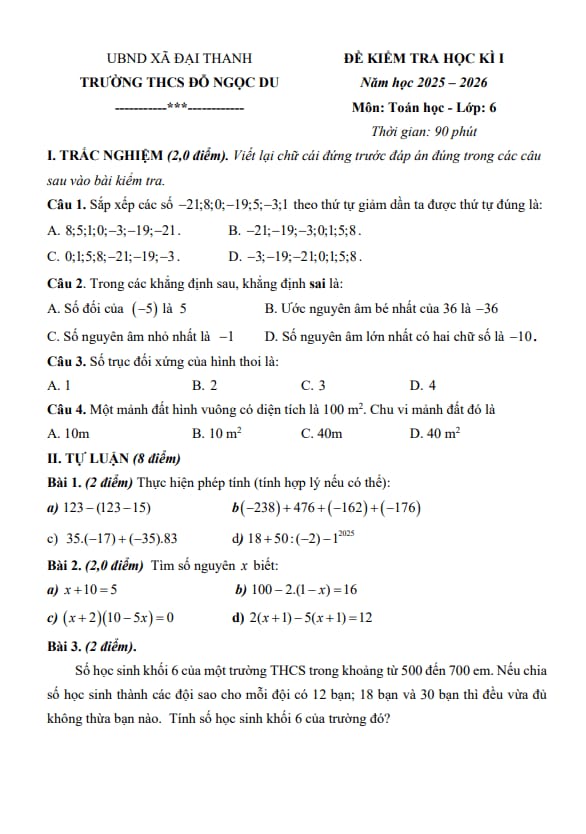
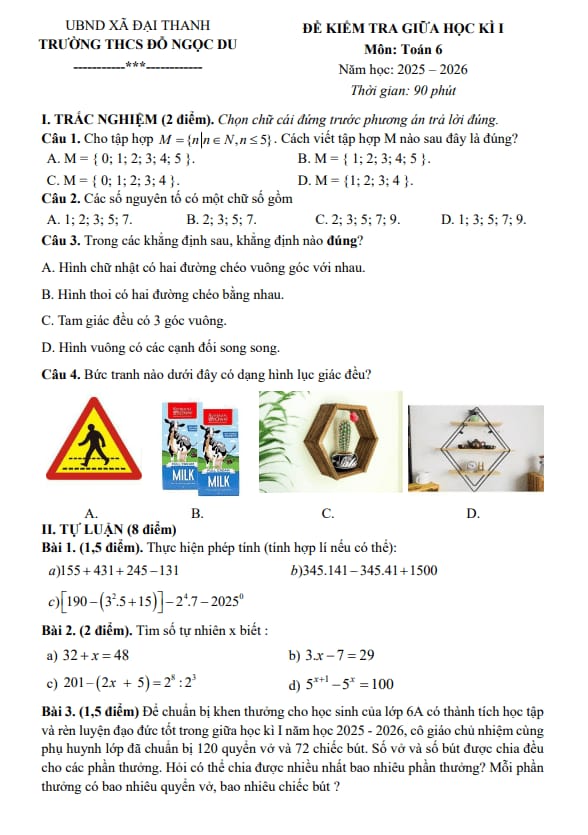
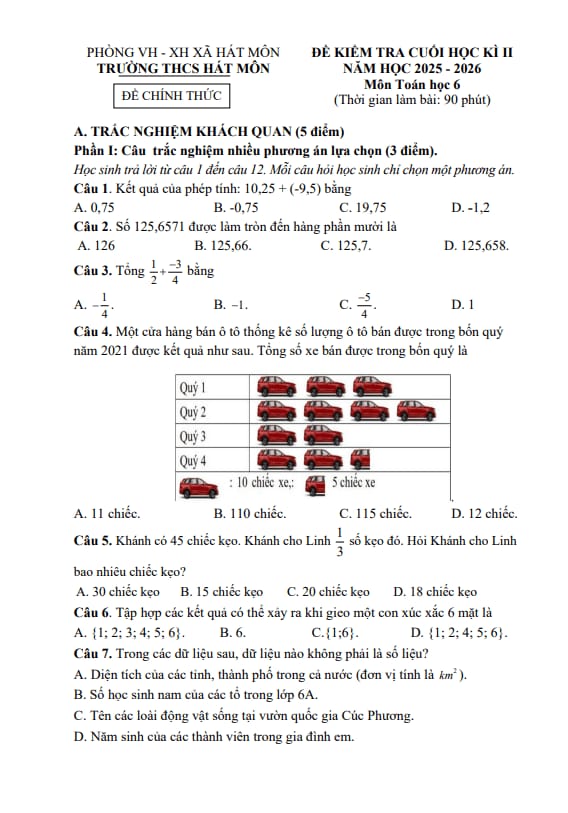
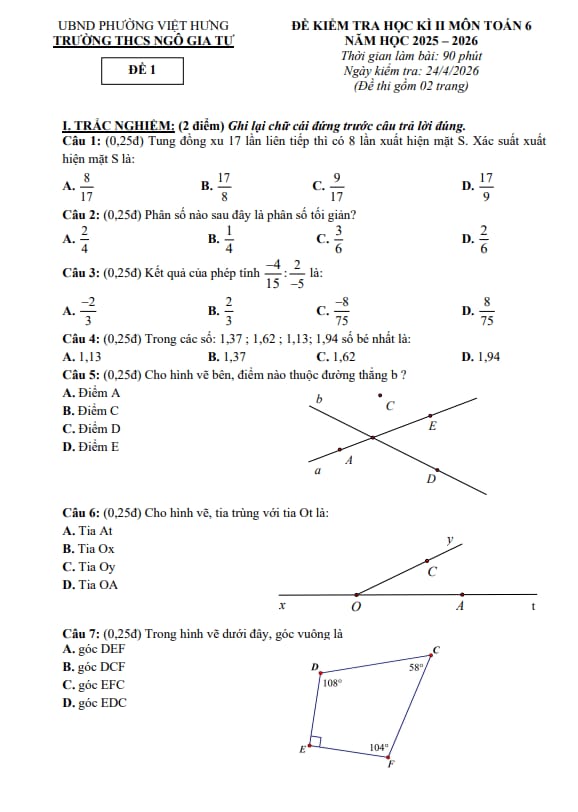
Chào mừng các em học sinh đến với bài học về Dạng 5. Tìm x trong Chủ đề 6 Ôn hè Toán 6. Đây là một dạng toán quan trọng, giúp các em rèn luyện kỹ năng giải phương trình đơn giản và áp dụng vào các bài toán thực tế.
Tại giaibaitoan.com, chúng tôi cung cấp các bài giảng chi tiết, dễ hiểu cùng với các bài tập đa dạng, từ cơ bản đến nâng cao, giúp các em nắm vững kiến thức và tự tin giải quyết các bài toán liên quan.
Dùng quy tắc thực hiện phép tính, quy tắc chuyển vế, quy tắc dấu ngoặc để đưa về các dạng quen thuộc để tìm x:
Dùng quy tắc thực hiện phép tính, quy tắc chuyển vế, quy tắc dấu ngoặc để đưa về các dạng quen thuộc để tìm x:
1) \(x + a = b \)
\(x = b - a\)
2) \(x - a = b\)
\(x = b + a\)
3) \(a - x = b\)
\(x = a - b\)
4) \(a.x = b\)
\(x = \dfrac{b}{a}\)
5) \(a:x = b\)
\(x = \dfrac{a}{b}\)
6) \(x:a = b\)
\(x = a.b\)
7) \(\dfrac{a}{b} = \dfrac{x}{c}\)
\(x = \dfrac{{a.c}}{b}\)
8) \({x^2} = {a^2}\)
\({x = a}\) hoặc \({x = - a}\)
9) \({x^3} = {a^3}\)
\(x = a\)
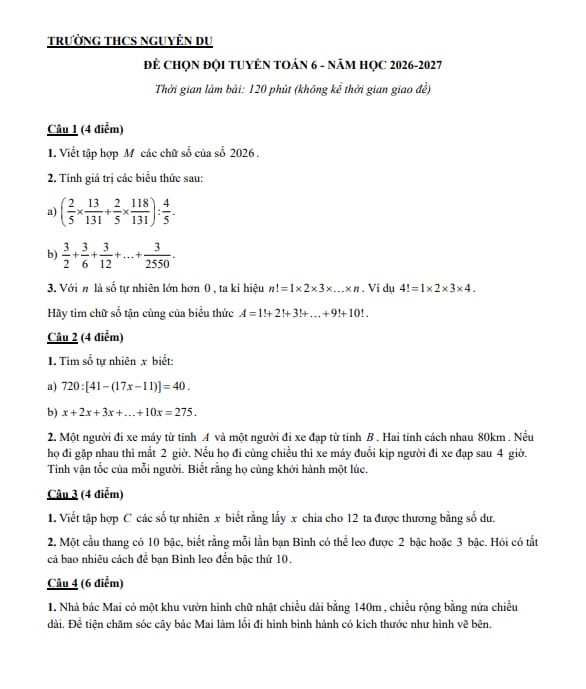
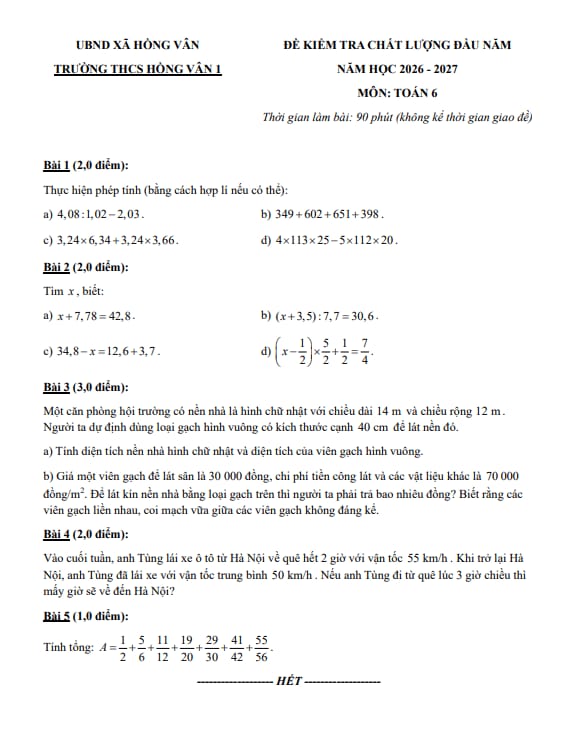
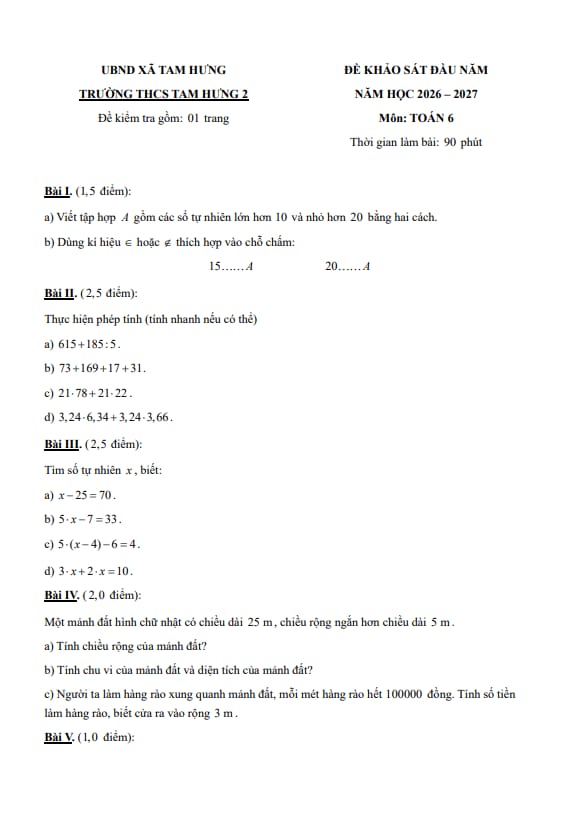
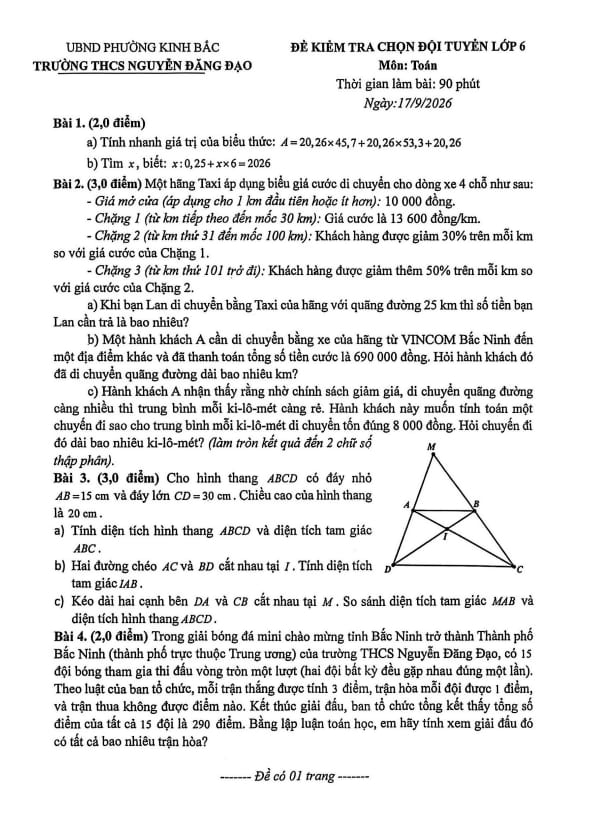
Bài 1:
Tìm x, biết:
\(\begin{array}{l}a)2x + 3 = 1\dfrac{2}{3}\\b)0,15 - 3x = {( - 10)^0}\\c) - x:\dfrac{2}{5} = 0,8\\d)\dfrac{{3x + 2}}{3} = \dfrac{{ - 4}}{5}\\e)\dfrac{{3x + 2}}{{ - 8}} = \dfrac{{ - 2}}{{3x + 2}}\\f)\left( {x + 1} \right).\left( { - 2x - 3} \right) = 0\end{array}\)
Bài 2:
Tìm \(x\), biết:
a) \(\dfrac{1}{3}x + \dfrac{2}{5}\left( {x - 1} \right) = 0\)
b) \(3 \cdot {\left( {3x - \dfrac{1}{2}} \right)^3} + \dfrac{1}{9} = 0\)
c) \(3 \cdot \left( {1 - \dfrac{1}{2}} \right) - 5 \cdot \left( {x + \dfrac{3}{5}} \right) = {\rm{ \;}} - x + \dfrac{1}{5}\)
d) \(\dfrac{{3 - x}}{{5 - x}} = {\left( {\dfrac{{ - 3}}{5}} \right)^2}\)
e) \(x\;:\;\dfrac{5}{8} = \dfrac{{ - 13}}{{35}} \cdot \dfrac{{15}}{{ - 39}}\)
f) \(\left( {\dfrac{7}{5}\; + \;x} \right):\dfrac{{25}}{{16}} = \dfrac{{ - 4}}{5}\)
g) \( - 4:\left( {x + \dfrac{{ - 2}}{3}} \right) = \dfrac{3}{4}\)
h) \(\left( {\dfrac{{ - 1}}{5} + 2} \right):\left( {x - \dfrac{7}{{10}}} \right) = \dfrac{{ - 1}}{4}\)
Bài 3:
Tìm tập hợp các số nguyên x để: \(\dfrac{5}{6} + \dfrac{{ - 7}}{8} \le \dfrac{x}{{24}} \le \dfrac{{ - 5}}{{12}} + \dfrac{5}{8}\)
Lời giải chi tiết:
Bài 1:
Tìm x, biết:
\(\begin{array}{l}a)2x + 3 = 1\dfrac{2}{3}\\b)0,15 - 3x = {( - 10)^0}\\c) - x:\dfrac{2}{5} = 0,8\\d)\dfrac{{3x + 2}}{3} = \dfrac{{ - 4}}{5}\\e)\dfrac{{3x + 2}}{{ - 8}} = \dfrac{{ - 2}}{{3x + 2}}\\f)\left( {x + 1} \right).\left( { - 2x - 3} \right) = 0\end{array}\)
Phương pháp
Áp dụng quy tắc thực hiện phép tính, quy tắc chuyển vế, quy tắc dấu ngoặc để đưa về các dạng quen thuộc để tìm x.
Lời giải
\(\begin{array}{l}a)2x + 3 = 1\dfrac{2}{3}\\2x + 3 = \dfrac{5}{3}\\2x = \dfrac{5}{3} - 3\\2x = \dfrac{5}{3} - \dfrac{9}{3}\\2x = \dfrac{{ - 4}}{3}\\x = \dfrac{{ - 4}}{3}:2\\x = \dfrac{{ - 4}}{3}.\dfrac{1}{2}\\x = \dfrac{{ - 2}}{3}\end{array}\)
Vậy \(x = \dfrac{{ - 2}}{3}\)
\(\begin{array}{l}b)0,15 - 3x = {( - 10)^0}\\0,15 - 3x = 1\\3x = 0,15 - 1\\3x = -0,85\\3x = -\dfrac{{17}}{{20}}\\x = -\dfrac{{17}}{{20}}:3\\x = -\dfrac{{17}}{{20}}.\dfrac{1}{3}\\x = -\dfrac{{17}}{{60}}\end{array}\)
Vậy \(x = -\dfrac{{17}}{{60}}\)
\(\begin{array}{l}c) - x:\dfrac{2}{5} = 0,8\\ - x:0,4 = 0,8\\ - x = 0,8.0,4\\ - x = 0,32\\x = - 0,32\end{array}\)
Vậy x = -0,32
\(\begin{array}{l}d)\dfrac{{3x + 2}}{3} = \dfrac{{ - 4}}{5}\\5.(3x + 2) = 3.( - 4)\\15x + 10 = - 12\\15x = - 12 - 10\\15x = - 22\\x = \dfrac{{ - 22}}{{15}}\end{array}\)
Vậy \(x = \dfrac{{ - 22}}{{15}}\)
\(\begin{array}{l}e)\dfrac{{3x + 2}}{{ - 8}} = \dfrac{{ - 2}}{{3x + 2}}\\\left( {3x + 2} \right).\left( {3x + 2} \right) = ( - 8).( - 2)\\{\left( {3x + 2} \right)^2} = 16\\{\left( {3x + 2} \right)^2} = {4^2}\end{array}\)
\(3x + 2 = 4\) hoặc \(3x + 2 = - 4\)
\(3x = 2\) hoặc \(3x = - 6\)
\(x = \dfrac{2}{3}\) hoặc \(x = - 2\)
Vậy \(x \in \left\{ {\dfrac{2}{3}; - 2} \right\}\)
\(\begin{array}{l}f)\left( {x + 1} \right).\left( { - 2x - 3} \right) = 0\end{array}\)
\(x + 1 = 0\) hoặc \( - 2x - 3 = 0\)
\(x = - 1\) hoặc \(x = \dfrac{{ - 3}}{2}\)
Vậy \(x \in \left\{ { - 1;\dfrac{{ - 3}}{2}} \right\}\)
Bài 2:
Tìm \(x\), biết:
a) \(\dfrac{1}{3}x + \dfrac{2}{5}\left( {x - 1} \right) = 0\)
b) \(3 \cdot {\left( {3x - \dfrac{1}{2}} \right)^3} + \dfrac{1}{9} = 0\)
c) \(3 \cdot \left( {1 - \dfrac{1}{2}} \right) - 5 \cdot \left( {x + \dfrac{3}{5}} \right) = {\rm{ \;}} - x + \dfrac{1}{5}\)
d) \(\dfrac{{3 - x}}{{5 - x}} = {\left( {\dfrac{{ - 3}}{5}} \right)^2}\)
e) \(x\;:\;\dfrac{5}{8} = \dfrac{{ - 13}}{{35}} \cdot \dfrac{{15}}{{ - 39}}\)
f) \(\left( {\dfrac{7}{5}\; + \;x} \right):\dfrac{{25}}{{16}} = \dfrac{{ - 4}}{5}\)
g) \( - 4:\left( {x + \dfrac{{ - 2}}{3}} \right) = \dfrac{3}{4}\)
h) \(\left( {\dfrac{{ - 1}}{5} + 2} \right):\left( {x - \dfrac{7}{{10}}} \right) = \dfrac{{ - 1}}{4}\)
Phương pháp
Áp dụng các qui tắc cộng, trừ, nhân, chia phân số, qui tắc tính giá trị của biểu thức.
Lời giải
a) \(\dfrac{1}{3}x + \dfrac{2}{5}\left( {x - 1} \right) = 0\)
\(\begin{array}{l}\dfrac{1}{3}x + \dfrac{2}{5}x - \dfrac{2}{5} = 0\\\left( {\dfrac{1}{3} + \dfrac{2}{5}} \right)x = \dfrac{2}{5}\\\dfrac{{11}}{{15}}x = \dfrac{2}{5}\end{array}\)
\(x = \dfrac{2}{5}:\dfrac{{11}}{{15}}\)
\(\begin{array}{l}x = \dfrac{2}{5} \cdot \dfrac{{15}}{{11}}\\x = \dfrac{6}{{11}}\end{array}\)
Vậy \(x = \dfrac{6}{{11}} \cdot \)
b) \(3.{\left( {3x - \dfrac{1}{2}} \right)^3} + \dfrac{1}{9} = 0\)
\(\begin{array}{l}3.{\left( {3x - \dfrac{1}{2}} \right)^3} = - \dfrac{1}{9}\\{\left( {3x - \dfrac{1}{2}} \right)^3} = - \dfrac{1}{9}:3\\{\left( {3x - \dfrac{1}{2}} \right)^3} = - \dfrac{1}{{27}} = \left( {\dfrac{{ - 1}}{3}} \right)\end{array}\)
\( \Rightarrow 3x - \dfrac{1}{2} = {\dfrac{{ - 1}}{3}^3}\)
\(\begin{array}{l}{\kern 1pt} {\kern 1pt} {\kern 1pt} {\kern 1pt} {\kern 1pt} {\kern 1pt} {\kern 1pt} {\kern 1pt} {\kern 1pt} {\kern 1pt} {\kern 1pt} {\kern 1pt} 3x = \dfrac{{ - 1}}{3} + \dfrac{1}{2}{\kern 1pt} {\kern 1pt} \\{\kern 1pt} {\kern 1pt} {\kern 1pt} {\kern 1pt} {\kern 1pt} {\kern 1pt} {\kern 1pt} {\kern 1pt} {\kern 1pt} {\kern 1pt} {\kern 1pt} {\kern 1pt} 3x = \dfrac{{ - 2}}{6} + \dfrac{3}{6}\\{\kern 1pt} {\kern 1pt} {\kern 1pt} {\kern 1pt} {\kern 1pt} {\kern 1pt} {\kern 1pt} {\kern 1pt} {\kern 1pt} {\kern 1pt} {\kern 1pt} {\kern 1pt} {\kern 1pt} {\kern 1pt} 3x = \dfrac{1}{6}{\kern 1pt} {\kern 1pt} \\{\kern 1pt} {\kern 1pt} {\kern 1pt} {\kern 1pt} {\kern 1pt} {\kern 1pt} {\kern 1pt} {\kern 1pt} {\kern 1pt} {\kern 1pt} {\kern 1pt} {\kern 1pt} {\kern 1pt} {\kern 1pt} {\kern 1pt} {\kern 1pt} x = \dfrac{1}{{18}}\end{array}\)
Vậy \(x = \dfrac{1}{{18}} \cdot \)
c) \(3.\left( {1 - \dfrac{1}{2}} \right) - 5\left( {x + \dfrac{3}{5}} \right) = {\rm{ \;}} - x + \dfrac{1}{5}\)
\(\begin{array}{*{20}{l}}{3 - \dfrac{3}{2} - \left( {5x + 5.\dfrac{3}{5}} \right) = {\rm{ \;}} - x + \dfrac{1}{5}}\\{\dfrac{3}{2} - 5x - 3 = {\rm{ \;}} - x + \dfrac{1}{5}}\\{ - 5x + x = \dfrac{1}{5} - \dfrac{3}{2} + 3}\end{array}\)
\(\begin{array}{*{20}{l}}{ - 4x = \dfrac{{ - 13}}{{10}} + 3}\\{ - 4x = \dfrac{{17}}{{10}}}\\{x = \dfrac{{17}}{{10}}:\left( { - 4} \right)}\\{x = {\rm{ \;}} - \dfrac{{17}}{{40}}}\end{array}\)
Vậy \(x = {\rm{ \;}} - \dfrac{{17}}{{40}} \cdot \)
d) \(\dfrac{{3 - x}}{{5 - x}} = {\left( {\dfrac{{ - 3}}{5}} \right)^2}\)
Điều kiện: \(5 - x \ne 0 \Leftrightarrow x \ne 5.\)
\(\begin{array}{*{20}{l}}{ \Rightarrow \dfrac{{3 - x}}{{5 - x}} = \dfrac{9}{{25}}}\\{ \Rightarrow \left( {3 - x} \right).25 = 9.\left( {5 - x} \right)}\\{{\kern 1pt} {\kern 1pt} {\kern 1pt} {\kern 1pt} {\kern 1pt} {\kern 1pt} {\kern 1pt} {\kern 1pt} {\kern 1pt} 75 - 25x = 45 - 9x{\kern 1pt} }\\{{\kern 1pt} {\kern 1pt} {\kern 1pt} {\kern 1pt} {\kern 1pt} - 25x + 9x = 45 - 75}\\{{\kern 1pt} {\kern 1pt} {\kern 1pt} {\kern 1pt} {\kern 1pt} {\kern 1pt} {\kern 1pt} {\kern 1pt} {\kern 1pt} {\kern 1pt} {\kern 1pt} {\kern 1pt} {\kern 1pt} {\kern 1pt} {\kern 1pt} - 16x = {\rm{ \;}} - 30}\\{{\kern 1pt} {\kern 1pt} {\kern 1pt} {\kern 1pt} {\kern 1pt} {\kern 1pt} {\kern 1pt} {\kern 1pt} {\kern 1pt} {\kern 1pt} {\kern 1pt} {\kern 1pt} {\kern 1pt} {\kern 1pt} {\kern 1pt} {\kern 1pt} {\kern 1pt} {\kern 1pt} {\kern 1pt} {\kern 1pt} {\kern 1pt} {\kern 1pt} {\kern 1pt} {\kern 1pt} x = \dfrac{{ - 30}}{{ - 16}} = \dfrac{{15}}{8}}\end{array}\)
Vậy \(x = \dfrac{{15}}{8} \cdot \)
e) \(x\;:\;\dfrac{5}{8} = \dfrac{{ - 13}}{{35}} \cdot \dfrac{{15}}{{ - 39}}\)
\(\begin{array}{*{20}{l}}{x:\dfrac{5}{8} = \dfrac{1}{7}}\\{x\;\;\;\;\; = \dfrac{1}{7} \cdot \dfrac{5}{8}}\\{x\;\;\;\;\; = \dfrac{5}{{56}}.}\end{array}\)
Vậy \(x = \dfrac{5}{{56}}\)
f) \(\left( {\dfrac{7}{5}\; + \;x} \right):\dfrac{{25}}{{16}} = \dfrac{{ - 4}}{5}\)
\(\begin{array}{*{20}{l}}{\dfrac{7}{5}\; + \;x\;\;\;\;\;\;\;\;\;\; = \dfrac{{ - 4}}{5} \cdot \dfrac{{25}}{{16}}}\\{\dfrac{7}{5}\; + \;x\;\;\;\;\;\;\;\;\;\; = \dfrac{{ - 5}}{4}}\\{\;\;{\kern 1pt} {\kern 1pt} {\kern 1pt} {\kern 1pt} {\kern 1pt} {\kern 1pt} {\kern 1pt} x\;\;\;\;\;\;\;\;\;\; = \dfrac{{ - 5}}{4} - \dfrac{7}{5}}\\{\;\;\;\;\;\;x\;\;\;\;\;\;\;\;\;\; = \dfrac{{ - 53}}{{20}}.}\end{array}\)
Vậy \(x = \dfrac{{ - 53}}{{20}}\).
g) \( - 4:\left( {x + \dfrac{{ - 2}}{3}} \right) = \dfrac{3}{4}\)
\(\begin{array}{*{20}{l}}{\;\;\;\;\;\;\;\;\;\;\;x + \dfrac{{ - 2}}{3} = {\rm{ \;}} - 4:\dfrac{3}{4}}\\{\;\;\;\;\;\;\;\;\;\;\;x + \dfrac{{ - 2}}{3} = {\rm{ \;}} - 4.\dfrac{4}{3}}\\{\;\;\;\;\;\;\;\;\;\;\;x + \dfrac{{ - 2}}{3} = \dfrac{{ - 16}}{3}}\\{\;\;\;\;\;\;\;\;\;\;\;x\;\;\;\;\;\;\;\; = \dfrac{{ - 16}}{3} - \left( {\dfrac{{ - 2}}{3}} \right)}\\{\;\;\;\;\;\;\;\;\;\;\;x\;\;\;\;\;\;\;\; = \dfrac{{ - 14}}{3}.}\end{array}\)
Vậy \(x = \dfrac{{ - 14}}{3}\).
h) \(\left( {\dfrac{{ - 1}}{5} + 2} \right):\left( {x - \dfrac{7}{{10}}} \right) = \dfrac{{ - 1}}{4}\)
\(\dfrac{{ - 1 + 10}}{5}:\left( {x - \dfrac{7}{{10}}} \right) = \dfrac{{ - 1}}{4}\)
\(\begin{array}{*{20}{l}}{\;\;\;\;\dfrac{9}{5}:\left( {x - \dfrac{7}{{10}}} \right) = \dfrac{{ - 1}}{4}}\\{\;\;\;\;\;\;\;\;\;\;x - \dfrac{7}{{10}} = \dfrac{9}{5}:\dfrac{{ - 1}}{4}}\\{\;\;\;\;\;\;\;\;\;\;x - \dfrac{7}{{10}} = \dfrac{9}{5}.\left( { - 4} \right)}\\{\;\;\;\;\;\;\;\;\;\;x - \dfrac{7}{{10}} = \dfrac{{ - 36}}{5}}\\{\;\;\;\;\;\;\;\;\;\;x\;\;\;\;\;\;\;\; = \dfrac{{ - 36}}{5} + \dfrac{7}{{10}}}\\{\;\;\;\;\;\;\;\;\;\;x\;\;\;\;\;\;\;\; = \dfrac{{ - 13}}{2}.}\end{array}\)
Vậy \(x = \dfrac{{ - 13}}{2}\)
Bài 3:
Tìm tập hợp các số nguyên x để: \(\dfrac{5}{6} + \dfrac{{ - 7}}{8} \le \dfrac{x}{{24}} \le \dfrac{{ - 5}}{{12}} + \dfrac{5}{8}\)
Phương pháp
+ Thực hiện phép cộng các phân số đã biết.
+ Xác định vai trò của số chưa biết trong phép toán rồi kết luận.
Lời giải
\(\begin{array}{*{20}{l}}{\dfrac{5}{6} + \dfrac{{ - 7}}{8} \le \dfrac{x}{{24}} \le \dfrac{{ - 5}}{{12}} + \dfrac{5}{8}}\\{ \Rightarrow \dfrac{{ - 1}}{{24}} \le \dfrac{x}{{24}} \le \dfrac{5}{{24}}}\\{ \Rightarrow {\rm{ \;}} - 1 \le x \le 5}\end{array}\)
Vì \(x \in \mathbb{Z}\) nên \(x \in \left\{ { - 1;0;1;2;3;4;5} \right\}\)
Vậy \(x \in \left\{ { - 1;0;1;2;3;4;5} \right\}\)
Dùng quy tắc thực hiện phép tính, quy tắc chuyển vế, quy tắc dấu ngoặc để đưa về các dạng quen thuộc để tìm x:
1) \(x + a = b \)
\(x = b - a\)
2) \(x - a = b\)
\(x = b + a\)
3) \(a - x = b\)
\(x = a - b\)
4) \(a.x = b\)
\(x = \dfrac{b}{a}\)
5) \(a:x = b\)
\(x = \dfrac{a}{b}\)
6) \(x:a = b\)
\(x = a.b\)
7) \(\dfrac{a}{b} = \dfrac{x}{c}\)
\(x = \dfrac{{a.c}}{b}\)
8) \({x^2} = {a^2}\)
\({x = a}\) hoặc \({x = - a}\)
9) \({x^3} = {a^3}\)
\(x = a\)
Bài 1:
Tìm x, biết:
\(\begin{array}{l}a)2x + 3 = 1\dfrac{2}{3}\\b)0,15 - 3x = {( - 10)^0}\\c) - x:\dfrac{2}{5} = 0,8\\d)\dfrac{{3x + 2}}{3} = \dfrac{{ - 4}}{5}\\e)\dfrac{{3x + 2}}{{ - 8}} = \dfrac{{ - 2}}{{3x + 2}}\\f)\left( {x + 1} \right).\left( { - 2x - 3} \right) = 0\end{array}\)
Bài 2:
Tìm \(x\), biết:
a) \(\dfrac{1}{3}x + \dfrac{2}{5}\left( {x - 1} \right) = 0\)
b) \(3 \cdot {\left( {3x - \dfrac{1}{2}} \right)^3} + \dfrac{1}{9} = 0\)
c) \(3 \cdot \left( {1 - \dfrac{1}{2}} \right) - 5 \cdot \left( {x + \dfrac{3}{5}} \right) = {\rm{ \;}} - x + \dfrac{1}{5}\)
d) \(\dfrac{{3 - x}}{{5 - x}} = {\left( {\dfrac{{ - 3}}{5}} \right)^2}\)
e) \(x\;:\;\dfrac{5}{8} = \dfrac{{ - 13}}{{35}} \cdot \dfrac{{15}}{{ - 39}}\)
f) \(\left( {\dfrac{7}{5}\; + \;x} \right):\dfrac{{25}}{{16}} = \dfrac{{ - 4}}{5}\)
g) \( - 4:\left( {x + \dfrac{{ - 2}}{3}} \right) = \dfrac{3}{4}\)
h) \(\left( {\dfrac{{ - 1}}{5} + 2} \right):\left( {x - \dfrac{7}{{10}}} \right) = \dfrac{{ - 1}}{4}\)
Bài 3:
Tìm tập hợp các số nguyên x để: \(\dfrac{5}{6} + \dfrac{{ - 7}}{8} \le \dfrac{x}{{24}} \le \dfrac{{ - 5}}{{12}} + \dfrac{5}{8}\)
Lời giải chi tiết:
Bài 1:
Tìm x, biết:
\(\begin{array}{l}a)2x + 3 = 1\dfrac{2}{3}\\b)0,15 - 3x = {( - 10)^0}\\c) - x:\dfrac{2}{5} = 0,8\\d)\dfrac{{3x + 2}}{3} = \dfrac{{ - 4}}{5}\\e)\dfrac{{3x + 2}}{{ - 8}} = \dfrac{{ - 2}}{{3x + 2}}\\f)\left( {x + 1} \right).\left( { - 2x - 3} \right) = 0\end{array}\)
Phương pháp
Áp dụng quy tắc thực hiện phép tính, quy tắc chuyển vế, quy tắc dấu ngoặc để đưa về các dạng quen thuộc để tìm x.
Lời giải
\(\begin{array}{l}a)2x + 3 = 1\dfrac{2}{3}\\2x + 3 = \dfrac{5}{3}\\2x = \dfrac{5}{3} - 3\\2x = \dfrac{5}{3} - \dfrac{9}{3}\\2x = \dfrac{{ - 4}}{3}\\x = \dfrac{{ - 4}}{3}:2\\x = \dfrac{{ - 4}}{3}.\dfrac{1}{2}\\x = \dfrac{{ - 2}}{3}\end{array}\)
Vậy \(x = \dfrac{{ - 2}}{3}\)
\(\begin{array}{l}b)0,15 - 3x = {( - 10)^0}\\0,15 - 3x = 1\\3x = 0,15 - 1\\3x = -0,85\\3x = -\dfrac{{17}}{{20}}\\x = -\dfrac{{17}}{{20}}:3\\x = -\dfrac{{17}}{{20}}.\dfrac{1}{3}\\x = -\dfrac{{17}}{{60}}\end{array}\)
Vậy \(x = -\dfrac{{17}}{{60}}\)
\(\begin{array}{l}c) - x:\dfrac{2}{5} = 0,8\\ - x:0,4 = 0,8\\ - x = 0,8.0,4\\ - x = 0,32\\x = - 0,32\end{array}\)
Vậy x = -0,32
\(\begin{array}{l}d)\dfrac{{3x + 2}}{3} = \dfrac{{ - 4}}{5}\\5.(3x + 2) = 3.( - 4)\\15x + 10 = - 12\\15x = - 12 - 10\\15x = - 22\\x = \dfrac{{ - 22}}{{15}}\end{array}\)
Vậy \(x = \dfrac{{ - 22}}{{15}}\)
\(\begin{array}{l}e)\dfrac{{3x + 2}}{{ - 8}} = \dfrac{{ - 2}}{{3x + 2}}\\\left( {3x + 2} \right).\left( {3x + 2} \right) = ( - 8).( - 2)\\{\left( {3x + 2} \right)^2} = 16\\{\left( {3x + 2} \right)^2} = {4^2}\end{array}\)
\(3x + 2 = 4\) hoặc \(3x + 2 = - 4\)
\(3x = 2\) hoặc \(3x = - 6\)
\(x = \dfrac{2}{3}\) hoặc \(x = - 2\)
Vậy \(x \in \left\{ {\dfrac{2}{3}; - 2} \right\}\)
\(\begin{array}{l}f)\left( {x + 1} \right).\left( { - 2x - 3} \right) = 0\end{array}\)
\(x + 1 = 0\) hoặc \( - 2x - 3 = 0\)
\(x = - 1\) hoặc \(x = \dfrac{{ - 3}}{2}\)
Vậy \(x \in \left\{ { - 1;\dfrac{{ - 3}}{2}} \right\}\)
Bài 2:
Tìm \(x\), biết:
a) \(\dfrac{1}{3}x + \dfrac{2}{5}\left( {x - 1} \right) = 0\)
b) \(3 \cdot {\left( {3x - \dfrac{1}{2}} \right)^3} + \dfrac{1}{9} = 0\)
c) \(3 \cdot \left( {1 - \dfrac{1}{2}} \right) - 5 \cdot \left( {x + \dfrac{3}{5}} \right) = {\rm{ \;}} - x + \dfrac{1}{5}\)
d) \(\dfrac{{3 - x}}{{5 - x}} = {\left( {\dfrac{{ - 3}}{5}} \right)^2}\)
e) \(x\;:\;\dfrac{5}{8} = \dfrac{{ - 13}}{{35}} \cdot \dfrac{{15}}{{ - 39}}\)
f) \(\left( {\dfrac{7}{5}\; + \;x} \right):\dfrac{{25}}{{16}} = \dfrac{{ - 4}}{5}\)
g) \( - 4:\left( {x + \dfrac{{ - 2}}{3}} \right) = \dfrac{3}{4}\)
h) \(\left( {\dfrac{{ - 1}}{5} + 2} \right):\left( {x - \dfrac{7}{{10}}} \right) = \dfrac{{ - 1}}{4}\)
Phương pháp
Áp dụng các qui tắc cộng, trừ, nhân, chia phân số, qui tắc tính giá trị của biểu thức.
Lời giải
a) \(\dfrac{1}{3}x + \dfrac{2}{5}\left( {x - 1} \right) = 0\)
\(\begin{array}{l}\dfrac{1}{3}x + \dfrac{2}{5}x - \dfrac{2}{5} = 0\\\left( {\dfrac{1}{3} + \dfrac{2}{5}} \right)x = \dfrac{2}{5}\\\dfrac{{11}}{{15}}x = \dfrac{2}{5}\end{array}\)
\(x = \dfrac{2}{5}:\dfrac{{11}}{{15}}\)
\(\begin{array}{l}x = \dfrac{2}{5} \cdot \dfrac{{15}}{{11}}\\x = \dfrac{6}{{11}}\end{array}\)
Vậy \(x = \dfrac{6}{{11}} \cdot \)
b) \(3.{\left( {3x - \dfrac{1}{2}} \right)^3} + \dfrac{1}{9} = 0\)
\(\begin{array}{l}3.{\left( {3x - \dfrac{1}{2}} \right)^3} = - \dfrac{1}{9}\\{\left( {3x - \dfrac{1}{2}} \right)^3} = - \dfrac{1}{9}:3\\{\left( {3x - \dfrac{1}{2}} \right)^3} = - \dfrac{1}{{27}} = \left( {\dfrac{{ - 1}}{3}} \right)\end{array}\)
\( \Rightarrow 3x - \dfrac{1}{2} = {\dfrac{{ - 1}}{3}^3}\)
\(\begin{array}{l}{\kern 1pt} {\kern 1pt} {\kern 1pt} {\kern 1pt} {\kern 1pt} {\kern 1pt} {\kern 1pt} {\kern 1pt} {\kern 1pt} {\kern 1pt} {\kern 1pt} {\kern 1pt} 3x = \dfrac{{ - 1}}{3} + \dfrac{1}{2}{\kern 1pt} {\kern 1pt} \\{\kern 1pt} {\kern 1pt} {\kern 1pt} {\kern 1pt} {\kern 1pt} {\kern 1pt} {\kern 1pt} {\kern 1pt} {\kern 1pt} {\kern 1pt} {\kern 1pt} {\kern 1pt} 3x = \dfrac{{ - 2}}{6} + \dfrac{3}{6}\\{\kern 1pt} {\kern 1pt} {\kern 1pt} {\kern 1pt} {\kern 1pt} {\kern 1pt} {\kern 1pt} {\kern 1pt} {\kern 1pt} {\kern 1pt} {\kern 1pt} {\kern 1pt} {\kern 1pt} {\kern 1pt} 3x = \dfrac{1}{6}{\kern 1pt} {\kern 1pt} \\{\kern 1pt} {\kern 1pt} {\kern 1pt} {\kern 1pt} {\kern 1pt} {\kern 1pt} {\kern 1pt} {\kern 1pt} {\kern 1pt} {\kern 1pt} {\kern 1pt} {\kern 1pt} {\kern 1pt} {\kern 1pt} {\kern 1pt} {\kern 1pt} x = \dfrac{1}{{18}}\end{array}\)
Vậy \(x = \dfrac{1}{{18}} \cdot \)
c) \(3.\left( {1 - \dfrac{1}{2}} \right) - 5\left( {x + \dfrac{3}{5}} \right) = {\rm{ \;}} - x + \dfrac{1}{5}\)
\(\begin{array}{*{20}{l}}{3 - \dfrac{3}{2} - \left( {5x + 5.\dfrac{3}{5}} \right) = {\rm{ \;}} - x + \dfrac{1}{5}}\\{\dfrac{3}{2} - 5x - 3 = {\rm{ \;}} - x + \dfrac{1}{5}}\\{ - 5x + x = \dfrac{1}{5} - \dfrac{3}{2} + 3}\end{array}\)
\(\begin{array}{*{20}{l}}{ - 4x = \dfrac{{ - 13}}{{10}} + 3}\\{ - 4x = \dfrac{{17}}{{10}}}\\{x = \dfrac{{17}}{{10}}:\left( { - 4} \right)}\\{x = {\rm{ \;}} - \dfrac{{17}}{{40}}}\end{array}\)
Vậy \(x = {\rm{ \;}} - \dfrac{{17}}{{40}} \cdot \)
d) \(\dfrac{{3 - x}}{{5 - x}} = {\left( {\dfrac{{ - 3}}{5}} \right)^2}\)
Điều kiện: \(5 - x \ne 0 \Leftrightarrow x \ne 5.\)
\(\begin{array}{*{20}{l}}{ \Rightarrow \dfrac{{3 - x}}{{5 - x}} = \dfrac{9}{{25}}}\\{ \Rightarrow \left( {3 - x} \right).25 = 9.\left( {5 - x} \right)}\\{{\kern 1pt} {\kern 1pt} {\kern 1pt} {\kern 1pt} {\kern 1pt} {\kern 1pt} {\kern 1pt} {\kern 1pt} {\kern 1pt} 75 - 25x = 45 - 9x{\kern 1pt} }\\{{\kern 1pt} {\kern 1pt} {\kern 1pt} {\kern 1pt} {\kern 1pt} - 25x + 9x = 45 - 75}\\{{\kern 1pt} {\kern 1pt} {\kern 1pt} {\kern 1pt} {\kern 1pt} {\kern 1pt} {\kern 1pt} {\kern 1pt} {\kern 1pt} {\kern 1pt} {\kern 1pt} {\kern 1pt} {\kern 1pt} {\kern 1pt} {\kern 1pt} - 16x = {\rm{ \;}} - 30}\\{{\kern 1pt} {\kern 1pt} {\kern 1pt} {\kern 1pt} {\kern 1pt} {\kern 1pt} {\kern 1pt} {\kern 1pt} {\kern 1pt} {\kern 1pt} {\kern 1pt} {\kern 1pt} {\kern 1pt} {\kern 1pt} {\kern 1pt} {\kern 1pt} {\kern 1pt} {\kern 1pt} {\kern 1pt} {\kern 1pt} {\kern 1pt} {\kern 1pt} {\kern 1pt} {\kern 1pt} x = \dfrac{{ - 30}}{{ - 16}} = \dfrac{{15}}{8}}\end{array}\)
Vậy \(x = \dfrac{{15}}{8} \cdot \)
e) \(x\;:\;\dfrac{5}{8} = \dfrac{{ - 13}}{{35}} \cdot \dfrac{{15}}{{ - 39}}\)
\(\begin{array}{*{20}{l}}{x:\dfrac{5}{8} = \dfrac{1}{7}}\\{x\;\;\;\;\; = \dfrac{1}{7} \cdot \dfrac{5}{8}}\\{x\;\;\;\;\; = \dfrac{5}{{56}}.}\end{array}\)
Vậy \(x = \dfrac{5}{{56}}\)
f) \(\left( {\dfrac{7}{5}\; + \;x} \right):\dfrac{{25}}{{16}} = \dfrac{{ - 4}}{5}\)
\(\begin{array}{*{20}{l}}{\dfrac{7}{5}\; + \;x\;\;\;\;\;\;\;\;\;\; = \dfrac{{ - 4}}{5} \cdot \dfrac{{25}}{{16}}}\\{\dfrac{7}{5}\; + \;x\;\;\;\;\;\;\;\;\;\; = \dfrac{{ - 5}}{4}}\\{\;\;{\kern 1pt} {\kern 1pt} {\kern 1pt} {\kern 1pt} {\kern 1pt} {\kern 1pt} {\kern 1pt} x\;\;\;\;\;\;\;\;\;\; = \dfrac{{ - 5}}{4} - \dfrac{7}{5}}\\{\;\;\;\;\;\;x\;\;\;\;\;\;\;\;\;\; = \dfrac{{ - 53}}{{20}}.}\end{array}\)
Vậy \(x = \dfrac{{ - 53}}{{20}}\).
g) \( - 4:\left( {x + \dfrac{{ - 2}}{3}} \right) = \dfrac{3}{4}\)
\(\begin{array}{*{20}{l}}{\;\;\;\;\;\;\;\;\;\;\;x + \dfrac{{ - 2}}{3} = {\rm{ \;}} - 4:\dfrac{3}{4}}\\{\;\;\;\;\;\;\;\;\;\;\;x + \dfrac{{ - 2}}{3} = {\rm{ \;}} - 4.\dfrac{4}{3}}\\{\;\;\;\;\;\;\;\;\;\;\;x + \dfrac{{ - 2}}{3} = \dfrac{{ - 16}}{3}}\\{\;\;\;\;\;\;\;\;\;\;\;x\;\;\;\;\;\;\;\; = \dfrac{{ - 16}}{3} - \left( {\dfrac{{ - 2}}{3}} \right)}\\{\;\;\;\;\;\;\;\;\;\;\;x\;\;\;\;\;\;\;\; = \dfrac{{ - 14}}{3}.}\end{array}\)
Vậy \(x = \dfrac{{ - 14}}{3}\).
h) \(\left( {\dfrac{{ - 1}}{5} + 2} \right):\left( {x - \dfrac{7}{{10}}} \right) = \dfrac{{ - 1}}{4}\)
\(\dfrac{{ - 1 + 10}}{5}:\left( {x - \dfrac{7}{{10}}} \right) = \dfrac{{ - 1}}{4}\)
\(\begin{array}{*{20}{l}}{\;\;\;\;\dfrac{9}{5}:\left( {x - \dfrac{7}{{10}}} \right) = \dfrac{{ - 1}}{4}}\\{\;\;\;\;\;\;\;\;\;\;x - \dfrac{7}{{10}} = \dfrac{9}{5}:\dfrac{{ - 1}}{4}}\\{\;\;\;\;\;\;\;\;\;\;x - \dfrac{7}{{10}} = \dfrac{9}{5}.\left( { - 4} \right)}\\{\;\;\;\;\;\;\;\;\;\;x - \dfrac{7}{{10}} = \dfrac{{ - 36}}{5}}\\{\;\;\;\;\;\;\;\;\;\;x\;\;\;\;\;\;\;\; = \dfrac{{ - 36}}{5} + \dfrac{7}{{10}}}\\{\;\;\;\;\;\;\;\;\;\;x\;\;\;\;\;\;\;\; = \dfrac{{ - 13}}{2}.}\end{array}\)
Vậy \(x = \dfrac{{ - 13}}{2}\)
Bài 3:
Tìm tập hợp các số nguyên x để: \(\dfrac{5}{6} + \dfrac{{ - 7}}{8} \le \dfrac{x}{{24}} \le \dfrac{{ - 5}}{{12}} + \dfrac{5}{8}\)
Phương pháp
+ Thực hiện phép cộng các phân số đã biết.
+ Xác định vai trò của số chưa biết trong phép toán rồi kết luận.
Lời giải
\(\begin{array}{*{20}{l}}{\dfrac{5}{6} + \dfrac{{ - 7}}{8} \le \dfrac{x}{{24}} \le \dfrac{{ - 5}}{{12}} + \dfrac{5}{8}}\\{ \Rightarrow \dfrac{{ - 1}}{{24}} \le \dfrac{x}{{24}} \le \dfrac{5}{{24}}}\\{ \Rightarrow {\rm{ \;}} - 1 \le x \le 5}\end{array}\)
Vì \(x \in \mathbb{Z}\) nên \(x \in \left\{ { - 1;0;1;2;3;4;5} \right\}\)
Vậy \(x \in \left\{ { - 1;0;1;2;3;4;5} \right\}\)
Dạng toán "Tìm x" trong chương trình Toán 6, đặc biệt là trong kỳ ôn hè, đóng vai trò quan trọng trong việc củng cố kiến thức về các phép toán cơ bản và làm quen với tư duy đại số. Dạng toán này yêu cầu học sinh phải hiểu rõ các quy tắc về phép cộng, trừ, nhân, chia và áp dụng chúng để tìm giá trị ẩn của biến x.
Dạng 5. Tìm x là việc tìm giá trị của ẩn số x sao cho phương trình hoặc biểu thức chứa x trở nên đúng. Các phương trình thường gặp có dạng:
Trong đó, a và b là các số đã biết, còn x là ẩn số cần tìm.
Ví dụ 1: Tìm x biết x + 5 = 12
Giải:
x = 12 - 5
x = 7
Ví dụ 2: Tìm x biết 3 * x = 21
Giải:
x = 21 / 3
x = 7
Để nắm vững kiến thức về Dạng 5. Tìm x, các em cần luyện tập thường xuyên với các bài tập đa dạng. Dưới đây là một số bài tập để các em tự luyện tập:
Để giải nhanh các bài toán tìm x, các em có thể áp dụng một số mẹo sau:
Dạng 5. Tìm x là một dạng toán quan trọng trong chương trình Toán 6. Việc nắm vững kiến thức và kỹ năng giải dạng toán này sẽ giúp các em tự tin hơn trong học tập và giải quyết các bài toán thực tế. Chúc các em học tốt!